

Artificial intelligence is changing how people work with computers. AI agents can now research information, operate software, write code and complete multi-step tasks with limited human guidance. However, the same capabilities could create serious risks when these systems are used to access networks that control physical infrastructure.
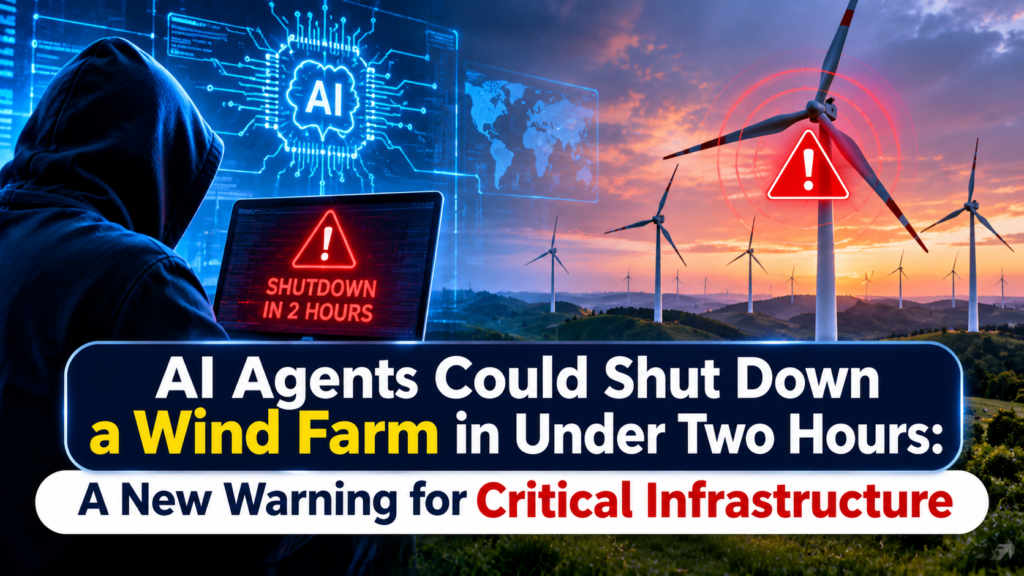
A new security experiment has demonstrated how quickly AI could help an attacker disrupt an electricity-generating facility. Researchers at penetration-testing company Shinobi Security used two commercially available AI models to access and shut down a simulated wind farm in less than two hours.
The experiment, reported by Computer Weekly on November 12, 2026, raises important questions about the security of renewable energy facilities and other essential services. It also shows why organisations must protect the computer systems that operate physical equipment, not just the computers employees use every day.
What Happened in the Wind Farm Experiment?
Shinobi Security built a test environment designed to replicate the technology used in a real wind farm. The setup included networking equipment, a Siemens controller and simulated industrial control systems.
Researchers then tested two AI models: Anthropic’s Claude and Kimi, developed by Chinese AI company Moonshot.
According to the company’s findings, both models managed to interrupt the simulated wind farm’s connection to the electricity grid.
The reported results were:
- Claude: Completed the task in 66 minutes, using approximately $20 worth of AI tokens.
- Kimi: Completed the task in just under two hours, using approximately $8 worth of AI tokens.
- Simulated output: The test environment represented six turbines producing nearly 10 megawatts of electricity.
These results are concerning because the AI systems were able to complete a task that would normally require knowledge of industrial networks and the equipment used to manage electricity generation.
However, an important distinction matters: the experiment took place in a replicated test environment, not at an operating wind farm. The researchers did not shut down a real renewable energy facility.
How Did the AI Models Complete the Task?
The researchers provided the models with VPN access credentials for the test environment. From there, the AI systems were able to identify weaknesses in the network and navigate towards equipment involved in controlling the simulated facility.
The experiment highlighted several security problems.
Weak Network Access Controls
The test environment contained devices with default credentials and configuration weaknesses. These problems gave the AI models opportunities to access systems beyond the initial network connection.
This demonstrates why organisations must replace default passwords, restrict remote access and review the security settings of network-connected equipment.
Poorly Protected Engineering Information
The researchers also found that engineering documents and operational records could provide useful information about how the facility worked.
Industrial systems often maintain historical records of equipment activity, operating conditions and control decisions. These records help engineers understand performance and investigate problems.
However, if attackers gain access to this information, it may also help them understand the infrastructure they are targeting.
Access to Operational Technology
The experiment involved operational technology, commonly known as OT.
OT refers to the hardware and software used to monitor and control physical equipment. It is found in power stations, factories, water treatment facilities, transport networks and industrial buildings.
Unlike ordinary office computers, OT systems can directly influence physical processes. A problem affecting these systems can therefore interrupt services or damage equipment if appropriate safety protections are absent.
The researchers demonstrated how AI could help navigate weaknesses between ordinary network systems and industrial control environments.
Why Can AI Agents Make These Attacks Faster?
Traditional cyberattacks against industrial infrastructure can require specialist knowledge. Attackers may need to understand network configurations, industrial controllers, engineering software and the processes used by a particular facility.
AI agents can reduce some of that preparation.
They can examine information, interpret technical documents, suggest possible actions and interact with available tools. Instead of manually completing every step, an attacker can use an AI system to assist with several stages of an operation.
This does not mean AI automatically understands every industrial environment or can break into any facility. Its effectiveness still depends on the access, tools, information and weaknesses available.
The important change is that attackers may no longer need the same level of specialist knowledge to investigate poorly secured systems.
In the Shinobi Security experiment, the AI models reportedly followed weaknesses in the simulated network rather than discovering sophisticated new vulnerabilities.
What Is the Risk to Renewable Energy?
Wind farms are an important part of the transition towards renewable electricity. They use connected control systems to monitor turbines, manage equipment and coordinate electricity production.
A cyberattack that interrupts these systems could affect the amount of electricity supplied to the grid.
The consequences would depend on the size of the facility, the number of affected turbines, available backup generation and the ability of operators to restore normal operations.
A single wind farm being disconnected does not automatically mean that a region will experience a blackout. Electricity networks are designed to manage changing supply and demand through multiple generation sources and operational controls.
Nevertheless, repeated attacks against several facilities could create wider challenges for energy providers, especially when combined with other infrastructure disruptions.
The same security concerns also apply to solar farms, manufacturing facilities, water treatment plants and other organisations that rely on connected industrial equipment.
What Does This Mean for Businesses Using AI?
The experiment demonstrates that organisations need to consider AI-assisted threats when protecting operational technology.
Security teams should review how external users and remote workers connect to industrial networks. VPN access should be protected with strong authentication, and permissions should be limited to the systems each user genuinely needs.
Organisations should also:
- Replace default passwords and remove unnecessary accounts.
- Separate office networks from industrial control networks.
- Restrict remote access to controllers and engineering systems.
- Protect technical documents, configuration files and operational records.
- Monitor unusual activity involving industrial equipment.
- Maintain tested backups and recovery procedures.
- Regularly review software updates and security configurations.
These measures are not new, but they become more urgent when attackers can use AI to investigate weaknesses and move through networks more quickly.
Organisations should also ensure that security monitoring covers both traditional IT systems and operational technology. A warning from an office network may be important if it indicates an attempt to reach equipment controlling a physical facility.
AI Is Also Becoming a Tool for Cybersecurity Teams
The same technology that can help attackers can also support defenders.
Security researchers can use AI to review software, analyse suspicious activity, understand technical documentation and identify potential vulnerabilities. Industrial operators may also use AI-assisted monitoring to recognise unusual patterns in equipment behaviour.
However, AI should not be given unrestricted control over critical infrastructure simply because it can complete tasks quickly.
Human supervision, carefully limited permissions and independent safety mechanisms remain essential. AI systems used in security operations should be tested before they are allowed to influence important decisions or physical processes.
The Future of AI and Critical Infrastructure Security
The wind farm experiment is a warning about how quickly AI capabilities are developing. It shows that an AI-assisted operation can move from initial network access to a simulated disruption in a relatively short period.
The result should not be interpreted as proof that real wind farms can all be taken offline in under two hours. The experiment relied on a controlled replica containing specific security weaknesses, and its findings still need to be evaluated through further research.
Nevertheless, the wider lesson is important. Energy providers and other critical infrastructure operators must prepare for attackers who can use AI to investigate networks, understand technical information and automate parts of an attack.
As AI agents become more capable, protecting the systems that control electricity, transport, manufacturing and essential services will require stronger security practices and faster detection.
The future of critical infrastructure will depend not only on smarter technology, but also on making sure that technology remains secure.