

Artificial intelligence is putting new pressure on the infrastructure that keeps the internet running. Modern AI systems need thousands of powerful processors working together, and those processors require enormous amounts of electricity. As data centres grow, supplying enough power safely and efficiently is becoming one of the industry’s biggest challenges.
A new development in China could offer a different way to handle that demand. Energy company Envision says it has deployed an integrated 800-volt direct-current (800V DC) power system at its Galaxy AI data centre in Ulanqab, Inner Mongolia. Announced on November 2, 2026, the system is already powering live computing workloads. The development could become an important step in how future AI facilities are designed.
What Is the New 800V DC Power System?
Most traditional data centres receive electricity as alternating current (AC) from the power grid. However, computer servers and many of their internal components operate using direct current (DC).
This means electricity usually passes through several conversion stages before reaching the hardware. Each conversion requires equipment and can introduce energy losses, additional heat and extra infrastructure.
The new system takes a different approach. Envision’s design converts incoming 10-kilovolt AC electricity into an 800V DC supply using a solid-state transformer. That direct-current supply can then be distributed towards computing equipment.
In simple terms, the system aims to reduce the number of steps between the electricity grid and the servers that run AI applications.
How Does the Technology Work?
The system combines three main technologies to manage electricity across the data centre.
1. Solid-State Transformers
A solid-state transformer handles the conversion of high-voltage electricity into a form suitable for the facility’s power distribution system. In Envision’s installation, it converts 10kV medium-voltage AC electricity into an 800V DC supply.
This approach is designed to simplify power delivery and reduce the need for multiple conversion stages.
2. Battery Energy Storage
The installation also includes battery energy storage. These batteries help respond when computing demand changes suddenly and can provide short-term backup power.
AI workloads do not always consume electricity at a constant rate. Large groups of processors can increase or decrease their power requirements as different tasks begin and finish. Battery storage can help manage some of these changes.
3. AI-Based Power Management
Envision uses its Dubhe Controller, supported by a model called the Dubhe Energy Foundation Model, to coordinate the transformers and batteries.
The company says the system can respond to changes in computing demand at millisecond-level intervals. Its purpose is to help balance electricity supply with the changing requirements of AI hardware.
Together, these technologies form an integrated power system rather than operating as separate pieces of equipment.
Why Do AI Data Centres Need More Efficient Power Systems?
AI data centres are different from many traditional computing facilities because they contain large numbers of specialised processors, including graphics processing units (GPUs).
These processors handle demanding tasks such as training AI models, generating images, analysing information and responding to user requests. When thousands of them operate together, their combined electricity requirements can become substantial.
Power delivery also affects how much computing hardware a facility can support. If electrical infrastructure takes up too much space or cannot supply enough power, operators may face limits on how many servers they can install.
An 800V DC architecture is designed to address some of these challenges.
Higher-voltage distribution can deliver the required power with lower current than a lower-voltage system. Under comparable conditions, this can reduce electrical losses and the amount of copper needed for power cables. A simpler conversion arrangement may also reduce equipment requirements.
However, the actual benefits depend on the design, operating conditions and hardware used at each facility.
What Makes China’s Deployment Significant?
Envision describes the installation as the world’s first commercial deployment of an integrated 800V DC power system in a large-scale AI data centre.
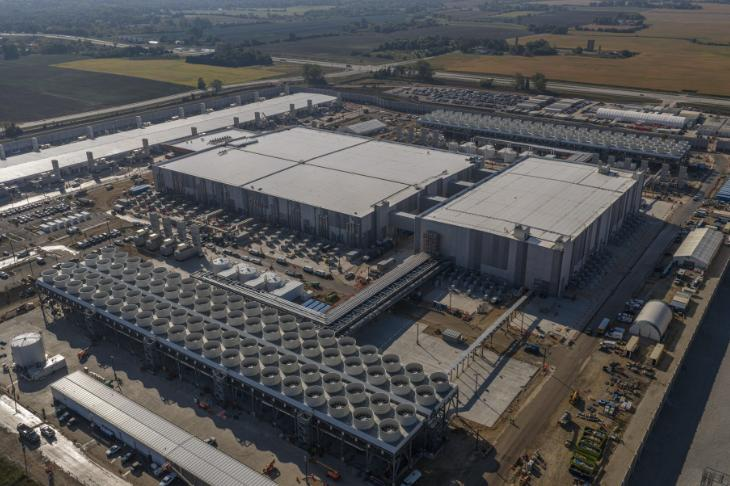
The system is operating at the company’s Galaxy AI campus in Ulanqab, Inner Mongolia. The campus began operations in August 2026, and the 800V system is now supporting live computing workloads.
The company has outlined ambitious plans for the site:
- Planned capacity: Up to 3 gigawatts.
- Future computing scale: Designed to support up to one million AI accelerators at full build-out.
- Renewable electricity: More than 80% of the campus’s power is planned to come from direct renewable electricity connections.
- Expansion target: Envision’s Mission Gobi initiative aims to develop 5GW of green AI data centre capacity in desert regions worldwide by 2030.
These figures describe planned capacity and future targets, not the amount of computing infrastructure already operating. The company has not disclosed the size of the 800V system currently running or the exact hardware it supports.
Could This Technology Change Future Data Centres?
The deployment arrives as technology companies look for better ways to power increasingly dense AI computing systems.
An 800V DC architecture could help data centre operators deliver more electricity to server racks while reducing some of the complexity associated with conventional power distribution. It may also support facilities that combine renewable energy, battery storage and high-performance computing.
The idea is attracting wider industry attention. Companies and industry groups have been exploring higher-voltage direct-current systems for future data centres. Microsoft and Meta, for example, have been involved in work on alternative power architectures through the Open Compute Project.
Envision’s deployment provides a commercial example of one approach. It does not mean that every data centre will immediately switch to 800V DC. Existing facilities use different electrical designs, and adopting a new architecture requires compatible equipment, safety systems and careful engineering.
What Are the Challenges and Limitations?
Although the deployment is an important development, several questions remain.
First, independent performance figures have not yet been published to confirm how much electricity the system saves compared with conventional data centre power infrastructure. Envision has described expected efficiency and space benefits, but these claims still need detailed independent measurements.
Second, high-voltage DC systems require specialised electrical protection, monitoring and maintenance. Data centres must maintain reliable power because even a short interruption can affect computing services.
Third, upgrading existing facilities may be more complicated than designing new buildings around the technology from the beginning. Operators would need to consider equipment compatibility, installation costs and long-term maintenance.
These factors will influence whether 800V DC systems become common across the global data centre industry.
The Future of AI Depends on More Than Powerful Chips
The race to develop better AI models is often discussed in terms of processors, software and computing performance. However, electricity delivery is becoming just as important.
Envision’s new 800V DC installation in China shows how data centre infrastructure is evolving to support the next generation of AI hardware. By combining solid-state transformers, battery storage and AI-based power management, the system aims to make electricity distribution more efficient and responsive.
Whether this approach becomes an industry standard will depend on real-world performance, cost and wider adoption. For now, it represents a significant commercial step in the search for better ways to power the growing demands of artificial intelligence.