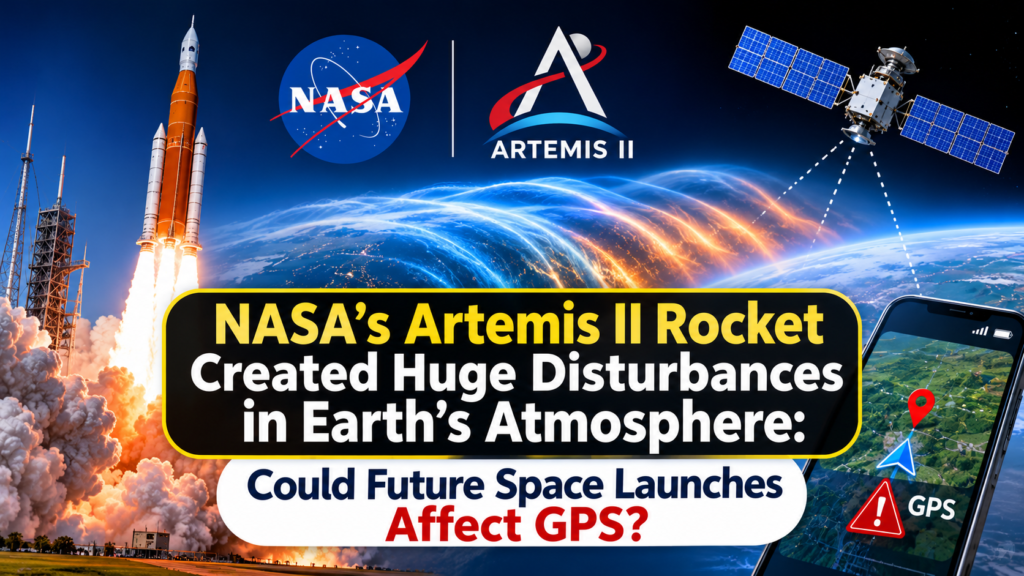

Rocket launches are designed to send spacecraft beyond Earth’s atmosphere, but their effects do not always end when the rocket disappears into space. A recent scientific study has revealed that NASA’s Artemis II mission also created enormous disturbances in a region of Earth’s upper atmosphere that plays an important role in satellite navigation.
The findings, reported in November 2026, show that the April 2026 Artemis II launch produced major disturbances in the ionosphere. Some extended approximately 5,000 kilometres across North America. Researchers say the changes could potentially affect GPS positioning accuracy by several metres.
This discovery raises an important question as space exploration becomes more frequent: could powerful rocket launches affect the navigation technology used by smartphones, aircraft, drones and autonomous vehicles?
What Did Researchers Discover After the Artemis II Launch?
NASA launched Artemis II on 1 April 2026 using its Space Launch System (SLS) rocket. The mission carried astronauts around the Moon and returned them safely to Earth, marking an important step in NASA’s plans for future lunar exploration.
However, researchers from Taiwan’s National Cheng Kung University later examined measurements from high-precision GPS receiver networks across the United States and identified unusual changes in the ionosphere following the mission.
The research identified large areas where the concentration of charged particles had changed. These disturbances were associated with the rocket’s journey through the upper atmosphere and the firing of its upper-stage engines.
The researchers identified two major disturbance regions, each extending approximately 5,000 kilometres across the American continent. The changes were particularly significant following the upper-stage engine burns.
The findings suggest that a rocket’s influence on Earth’s atmosphere can extend far beyond the immediate launch location.
What Is the Ionosphere and Why Does It Matter?
The ionosphere is a region of Earth’s upper atmosphere containing electrically charged particles called ions and free electrons. It begins roughly 50 kilometres above Earth’s surface and extends through several atmospheric layers.
It plays an important role in radio communication and satellite navigation because signals travelling between satellites and receivers must pass through it.
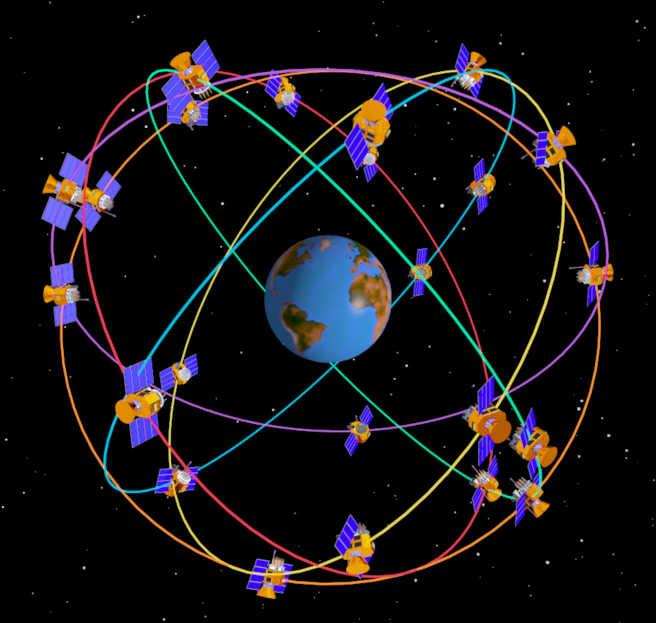
GPS satellites transmit signals containing information that receivers use to calculate their location. A smartphone, vehicle navigation system or GPS device estimates its position by measuring how long signals take to travel from multiple satellites.
However, the ionosphere can change the speed at which these signals travel.
When the concentration of free electrons changes, GPS signals can experience delays. These changes can affect the accuracy of the distance measurements used to calculate a receiver’s position.
Under normal conditions, GPS systems use correction techniques to reduce many atmospheric errors. However, unusual disturbances can make accurate positioning more difficult.
How Did the Artemis II Rocket Disturb the Atmosphere?
A rocket travelling at extremely high speed creates shock waves as it moves through the atmosphere. Its exhaust also releases gases and water vapour that can interact with the surrounding environment.
These processes can change the concentration of charged particles in the ionosphere, creating temporary regions of reduced electron density.
Researchers identified disturbances associated with different stages of the Artemis II mission.
The main rocket stage: As the Space Launch System travelled upwards, its movement through the atmosphere created a disturbance along its flight path.
Upper-stage engine burns: The rocket’s upper stage later fired its engines at an altitude of approximately 185 kilometres. These burns produced particularly prominent changes in the ionosphere.
The upper-stage burns were especially important because they occurred directly within the ionosphere. Their effects were more pronounced than the disturbance associated with the rocket’s initial ascent.
This shows that the location and timing of an engine burn can matter as much as the overall power of a rocket when studying its atmospheric effects.
Could Rocket Launches Affect GPS Navigation?
GPS is used in far more places than smartphone maps. It supports vehicle navigation, aircraft operations, shipping, surveying, agriculture, emergency services and many industrial systems.
A positioning error of several metres may not be a serious problem for someone walking through a city. However, the same error could matter when a system needs to determine its location with greater precision.
Researchers have highlighted several areas where atmospheric disturbances deserve attention.
Autonomous vehicles: Self-driving systems use positioning information alongside cameras, radar, lidar and other sensors. A positioning error could affect how a vehicle understands its location, particularly when combined with other limitations.
Drones: Commercial and industrial drones depend on satellite navigation for flight planning, positioning and automated operations. Unexpected location errors could complicate some tasks.
Aircraft and shipping: Aviation and maritime systems use satellite navigation as part of wider navigation systems. Reliable positioning is important for routes, monitoring and safety procedures.
Surveying and agriculture: High-precision GPS equipment helps surveyors measure land and allows agricultural machinery to follow accurate routes. Atmospheric disturbances can affect this precision.
However, the study did not establish that widespread GPS failures, vehicle accidents or drone incidents actually occurred during the Artemis II launch. The researchers measured atmospheric changes that could translate into positioning errors, rather than documenting real-world navigation failures.
How Is This Different From a Solar Storm?
Solar storms are another major source of disturbances in Earth’s ionosphere.
When the Sun releases large amounts of charged particles and energy, they can interact with Earth’s magnetic field and upper atmosphere. Strong geomagnetic storms can affect radio communication, satellite operations and GPS accuracy.
Rocket-related disturbances are different because they are created by human activity rather than solar activity.
| Feature | Solar storms | Rocket-related disturbances |
| Main cause | Solar activity and charged particles | Rocket movement and engine exhaust |
| Affected region | Can affect large parts of Earth | Often follows specific rocket paths |
| Duration | Can last for hours or days | Generally shorter-lived |
| Main concern | Communication and navigation disruption | Localised atmospheric changes and possible navigation errors |
| Predictability | Monitored through space-weather forecasting | Depends on launch timing, trajectory and engine activity |
Both events demonstrate how conditions in the upper atmosphere can influence technologies that depend on signals travelling from space to Earth.
Why This Discovery Matters for Future Space Missions
The Artemis programme is part of NASA’s wider effort to return astronauts to the Moon and develop the technology needed for future exploration.
As more countries and private companies launch rockets, the number of missions travelling through Earth’s atmosphere is expected to increase.
Future missions may involve larger rockets, reusable launch vehicles, more frequent satellite deployments and spacecraft travelling towards the Moon and Mars.
Scientists will therefore need a better understanding of how these activities affect the atmosphere.
The Artemis II findings could help researchers improve atmospheric monitoring and develop better models for predicting changes that may affect satellite navigation.
They may also encourage space agencies and navigation technology providers to consider rocket-related atmospheric disturbances when planning future missions.
Can GPS Systems Be Protected From These Disturbances?
GPS technology already uses several methods to reduce errors caused by atmospheric conditions.
These include correction models, ground-based reference stations and advanced receivers that can compare signals from multiple frequencies.
Some high-precision navigation systems also use additional satellite constellations, such as Galileo, GLONASS and BeiDou, to improve positioning availability.
Other technologies can provide additional information when satellite navigation becomes unreliable. Autonomous vehicles, for example, can combine satellite positioning with cameras, lidar, radar and onboard sensors.
Researchers can also use networks of ground-based receivers to monitor changes in the ionosphere and improve their understanding of how rocket launches affect navigation signals.
These systems cannot eliminate every possible error, but combining different technologies can make navigation more reliable.
The Future of Space Exploration and GPS Technology
The Artemis II findings reveal an unexpected connection between space exploration and everyday technology. A rocket travelling towards the Moon can create disturbances in Earth’s upper atmosphere, a region that satellite navigation signals must pass through before reaching users on the ground.
The research does not mean that ordinary GPS services are about to stop working because of rocket launches. The measured effects were temporary, and widespread navigation failures were not established.
However, the discovery highlights an important challenge for the future. As space missions become more frequent, scientists will need to understand not only what happens beyond Earth but also how rocket activity affects the systems people depend on at home.
Space exploration is advancing rapidly, and protecting the technology that supports life on Earth will remain an important part of that progress.