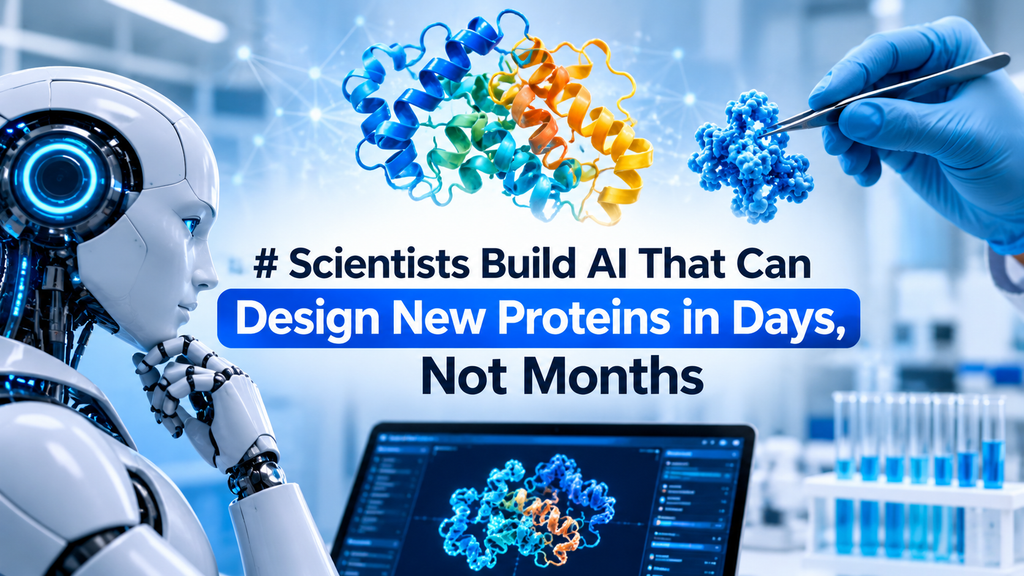


Artificial intelligence is beginning to change more than how people write, search or communicate. Researchers are now using advanced AI models to design biological molecules that could eventually support new medicines, improve industrial processes and address environmental problems.
On October 21, 2026, researchers at the University of Washington’s Institute for Protein Design introduced RFD4-Proteina, an open-source generative AI model developed in collaboration with NVIDIA. The model is designed to help scientists create proteins with specific functions by reasoning about how biological molecules interact.
The research team reported that the model achieved five to ten times higher design success rates and generated protein candidates five to ten times faster than previous methods across computational benchmarks. Laboratory testing also showed that its designed proteins could perform as expected in experimental settings.
The development highlights an important direction in biotechnology: using AI not only to understand existing biological systems but also to help design new ones.
What Is Protein Design?
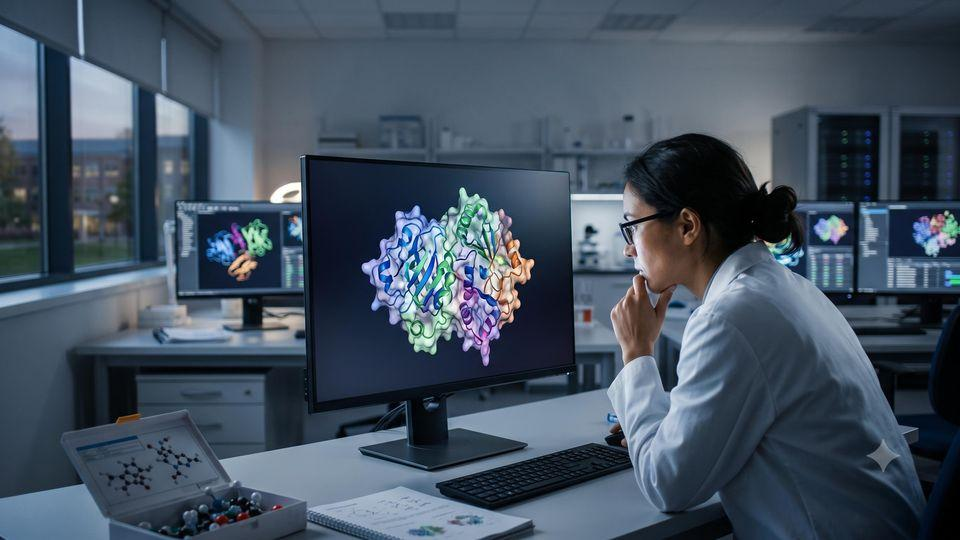
Proteins are essential molecules found in every living organism. They perform many important functions, including transporting substances, supporting immune responses, breaking down food and helping cells communicate.
A protein is made from a sequence of amino acids. The sequence determines how the protein folds into a three-dimensional structure, and that structure influences what the protein can do.
Protein design involves creating or modifying these sequences to produce a desired function. Scientists may want to develop a protein that recognises a particular molecule, breaks down a harmful substance or interacts with a specific biological target.
Traditionally, designing and testing suitable proteins can require extensive computational work and laboratory experiments. Researchers may need to explore many possible sequences before finding one that performs the intended task.
AI models can help narrow this search by predicting promising designs before scientists move to physical testing.
What Is RFD4-Proteina?
RFD4-Proteina is a generative model developed by researchers from the University of Washington’s Institute for Protein Design and NVIDIA.
It combines two research approaches: the RosettaFold Diffusion model family developed by the Institute for Protein Design and NVIDIA’s Proteina-Complexa technology.
Unlike approaches that mainly learn patterns from existing protein examples, RFD4-Proteina uses biomolecular reasoning to consider how proteins interact with other molecules. It can refine a protein’s sequence and structure alongside the structures of interacting molecules.
This matters because a protein does not work in isolation. Its function often depends on how its shape and chemical properties fit with other biological components.
The researchers reported that RFD4-Proteina achieved five to ten times higher design success rates and generated candidates five to ten times faster than previous methods on computational benchmarks. Laboratory experiments also validated selected designs.
The model has been released as an open-source resource, allowing researchers to explore its capabilities and build on the technology.
How Could AI-Designed Proteins Change Medicine?
One of the most important potential applications is medicine.
Many diseases involve biological processes that could be influenced by carefully designed proteins. Researchers are interested in developing molecules that recognise specific targets, interact with disease-related proteins or support the immune system.
AI-assisted protein design could help scientists explore possibilities that would otherwise take considerable time to investigate.
Potential applications include:
New therapeutic proteins: Researchers could design proteins that interact with specific biological targets, potentially supporting future treatments.
Improved antibodies: Protein design could help develop molecules that recognise particular targets, which is important in research involving immune responses and disease treatment.
Better drug development: Designed proteins may help scientists investigate biological pathways and identify new approaches for developing medicines.
More targeted research: Instead of testing an extremely large number of possibilities, researchers can use computational models to prioritise promising candidates for laboratory experiments.
However, an AI-designed protein is not automatically a medicine. It must undergo further testing for safety, effectiveness, stability and possible side effects before it can be considered for clinical use.
Beyond Healthcare: Environmental and Industrial Applications
The potential of protein design extends beyond medicine. Proteins and enzymes can perform chemical tasks that are useful in manufacturing, agriculture and environmental research.
For example, researchers are exploring enzymes that can break down plastics and other difficult materials. Better-designed enzymes could eventually support recycling processes and reduce the environmental impact of certain industrial activities.
The University of Washington research team also highlighted an example involving a pesticide-degrading enzyme. A researcher involved in the project reported designing an improved version in a few days, compared with months spent developing an earlier version.
Other possible areas include:
- Biotechnology: Designing proteins for specialised biological processes.
- Agriculture: Exploring enzymes and proteins that could support more sustainable farming methods.
- Manufacturing: Developing biological alternatives for certain industrial chemical processes.
- Environmental research: Investigating proteins that can break down selected pollutants and difficult materials.
- Materials science: Using biological molecules to support the development of new functional materials.
These applications are still at different stages of research. Their practical value will depend on experimental performance, cost, safety and the ability to scale production.
Why Open-Source Protein Design Matters
Another important part of the RFD4-Proteina announcement is its open-source release.
Advanced biological design tools can require significant computing resources, specialist knowledge and access to research infrastructure. Making a model available to the wider research community gives more scientists the opportunity to examine its methods, test its capabilities and develop new applications.
Universities, biotechnology researchers and independent research teams may be able to build on the model rather than developing every component from the beginning.
Open access can also encourage collaboration. Researchers can compare results, identify weaknesses and explore improvements across different areas of biology.
However, open access does not remove the need for responsible use. Protein-design technologies should be developed with appropriate scientific oversight, safety checks and controls against harmful applications.
What Are the Limitations of AI Protein Design?
Despite the progress, AI protein design still faces important challenges.
Laboratory validation is essential: A model may predict that a protein will perform a particular function, but real biological environments are complex. Predictions must be tested experimentally.
Safety and stability: A designed protein must remain stable and behave as intended. Researchers also need to investigate unwanted interactions and possible biological risks.
Computational requirements: Advanced models can require powerful hardware and significant computing resources, which may limit access for smaller research teams.
Clinical development takes time: Even a promising protein candidate must pass through further research, preclinical evaluation and clinical trials before it can become an approved treatment.
Real-world production: Producing a protein consistently, affordably and at a large scale can introduce challenges that are not fully represented in computational predictions.
These limitations explain why AI should be viewed as a research tool that supports scientists, rather than a replacement for laboratory work and expert judgement.
The Future of AI in Biotechnology
RFD4-Proteina represents a growing shift in how researchers approach biological design. Instead of relying entirely on traditional trial-and-error methods, scientists can increasingly use computational systems to explore possible protein structures and prioritise promising candidates.
As these tools improve, AI-assisted design could become part of a wider research process connecting computational predictions, laboratory experiments and biological analysis.
The most important progress will not simply be how quickly an AI model generates a protein. It will be whether scientists can consistently turn those designs into safe, useful and affordable solutions.
AI is not replacing biology or the scientists who study it. It is giving them another way to explore the complexity of life, and that could influence the future of medicine, biotechnology and environmental innovation.