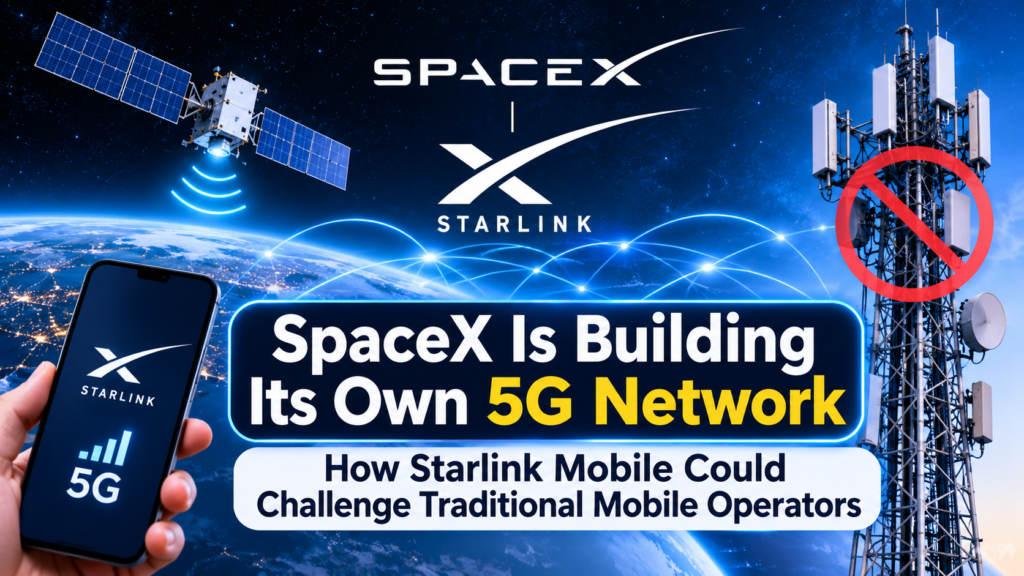


For years, SpaceX has been expanding its Starlink satellite internet service to connect people in areas where traditional broadband networks are difficult to build. Now, the company is moving into another major part of the telecommunications industry: mobile networks.
On 4 November 2026, Qualcomm announced a multi-year agreement with SpaceX to provide technology for Starlink Mobile’s planned nationwide 5G network in the United States. The project will use Qualcomm’s cellular infrastructure platforms to support thousands of ground-based mobile network sites, with deployment expected to begin in 2027.
The development could put SpaceX in direct competition with established mobile operators such as AT&T, Verizon and T-Mobile. More importantly, it introduces a different approach to connectivity by combining satellite coverage with traditional mobile network infrastructure.

What Is Starlink Mobile?
Starlink Mobile is SpaceX’s planned mobile connectivity network. It aims to combine satellite communication with ground-based cellular infrastructure to provide mobile connectivity across the United States.
Traditional mobile networks depend on cell towers and other ground-based equipment. These systems provide strong coverage in many cities and populated areas, but coverage can become limited in remote locations, mountains, rural communities and areas where building infrastructure is expensive.
Starlink uses satellites in low Earth orbit to provide internet connectivity in locations where traditional networks may be unavailable or unreliable.
By combining these two approaches, SpaceX wants to develop a network that can provide both conventional mobile coverage and satellite connectivity.
The important point is that Starlink Mobile is not simply another name for satellite internet. The new project includes a planned terrestrial 5G network with thousands of cellular sites.
SpaceX Selects Qualcomm to Build Its 5G Infrastructure
Qualcomm will supply its Dragonwing Cellular Infrastructure platforms for Starlink Mobile’s planned ground-based network.
The agreement includes two main platforms:
- Dragonwing QRU100: Handles important radio functions within the cellular infrastructure.
- Dragonwing QDU100: Supports baseband processing, which helps manage the digital signals transmitted and received by the network.
These technologies will support the radio equipment and processing systems required at mobile network sites.
According to Qualcomm, SpaceX plans to deploy equipment across tens of thousands of sites through a multi-year agreement. The rollout is expected to begin in 2027.
Qualcomm also described the agreement as its biggest 5G deal so far. However, the companies have not disclosed the financial value of the contract.
The partnership is significant for Qualcomm because it expands its role beyond smartphone processors into the infrastructure that powers mobile networks.
How Will the Starlink Mobile 5G Network Work?
The planned network will use a combination of ground-based cellular sites and satellite connectivity.
To understand the idea, it helps to look at how each part works.
1. Ground-based 5G sites
Traditional cellular sites use antennas and radio equipment to connect nearby smartphones and other compatible devices. Starlink Mobile plans to deploy tens of thousands of these sites across the United States.
2. Satellite connectivity
Starlink satellites operate in low Earth orbit and communicate with ground infrastructure and compatible devices or network equipment. This can help extend connectivity into areas where conventional mobile coverage is limited.
3. Network integration
The broader goal is to combine satellite and terrestrial infrastructure into a connected system. Ground-based 5G sites can provide capacity in populated areas, while satellite connectivity can help reach locations that are difficult to cover using towers alone.
4. Mobile device connection
Users will need compatible devices and an appropriate service plan. The exact devices, supported bands, service arrangements and customer pricing for the planned nationwide network have not yet been fully announced.
This combination could create a different type of mobile network, although its performance will depend on coverage, available spectrum, infrastructure and how well the two systems work together.
What Is Massive MIMO and Why Does It Matter?
One of the important technologies mentioned in Qualcomm’s announcement is Massive MIMO.
MIMO stands for Multiple Input, Multiple Output. It uses multiple antennas to transmit and receive wireless signals.
Massive MIMO takes this approach further by using a larger number of antenna elements to serve multiple users and improve the use of available radio spectrum.
Starlink Mobile’s planned terrestrial network will use radio units with 64 transmit and 64 receive paths, known as 64T64R.
This technology can help improve several aspects of a mobile network:
- Higher capacity: More users can be served efficiently within the available spectrum.
- Better coverage: Antenna technology can help direct signals towards users.
- Improved efficiency: Network equipment can make better use of available radio frequencies.
- Beamforming: Signals can be directed towards specific devices instead of being transmitted equally in every direction.
These improvements are important when building a large mobile network because operators need to serve many users without wasting limited wireless spectrum.
How Could SpaceX Challenge AT&T, Verizon and T-Mobile?
The US mobile market is already dominated by established operators with extensive infrastructure, large customer bases and years of experience.
SpaceX will need to compete with companies that have spent decades developing their networks.
However, its existing satellite infrastructure could give it a different starting point.
| Feature | Traditional mobile operators | Starlink Mobile’s planned approach |
| Main infrastructure | Ground-based cell towers | Ground-based 5G sites combined with satellite connectivity |
| Coverage strategy | Cellular coverage across populated and rural areas | Terrestrial coverage supported by satellite connectivity |
| Network technology | 4G and 5G infrastructure | Planned terrestrial 5G and integrated satellite connectivity |
| Main challenge | Expanding coverage and capacity | Building a competitive ground network and integrating satellite services |
| Market position | Established mobile operators | New competitor entering the US mobile market |
The potential advantage is not simply having satellites. It is the possibility of combining two types of network infrastructure to address different coverage requirements.
However, SpaceX will still need to build or secure access to thousands of ground-based sites, obtain sufficient spectrum, establish customer services and compete on pricing and performance.
What Could This Mean for Smartphone Users?
If the project develops successfully, consumers could eventually have another option for mobile connectivity.
Potential benefits include:
More connectivity options: Satellite and terrestrial networks could work together to improve access in areas where traditional coverage is limited.
Improved rural connectivity: Remote communities may benefit from additional connectivity options, although actual coverage will depend on the network’s deployment.
More competition: A new mobile operator could encourage existing providers to improve their services, pricing and coverage.
Better support for connected devices: A combined network could eventually support more than smartphones, including vehicles, delivery systems and other connected equipment.
However, these benefits are potential outcomes, not confirmed features of a service that is already available. SpaceX has not yet published a complete consumer launch plan for the new nationwide network.
The Biggest Challenges Facing Starlink Mobile
Building a nationwide mobile network is a major undertaking. Satellite infrastructure alone cannot replace the capacity and coverage provided by thousands of ground-based cellular sites.
SpaceX faces several important challenges.
Infrastructure costs: Building or accessing towers, installing radio equipment and connecting sites to the wider network requires substantial investment.
Spectrum availability: Mobile operators need suitable radio frequencies to provide reliable services. SpaceX must ensure it has sufficient spectrum for its planned network.
Competition: AT&T, Verizon and T-Mobile already have extensive coverage, established customers and mature mobile service operations.
Indoor coverage: Satellite signals can help in open areas, but providing strong service inside buildings and in dense urban locations remains a challenge.
Service availability: Even after deployment begins in 2027, building a reliable nationwide network will take time. The first installation phase does not mean the service will immediately be available everywhere.
These challenges will determine whether SpaceX can become a serious competitor in the mobile telecommunications market.
Could This Change the Future of Mobile Connectivity?
SpaceX’s partnership with Qualcomm represents an important step towards its plan to enter the traditional mobile network market.
The project also reflects a wider change in telecommunications. Companies are increasingly exploring ways to combine satellites, cellular infrastructure and advanced network technology rather than relying on a single method of connectivity.
In the longer term, this approach could support connected vehicles, autonomous systems, delivery drones and other devices that require reliable communication across large areas.
Qualcomm has also described the partnership as a step towards its broader vision of AI-native 6G infrastructure. However, the current deployment is focused on terrestrial 5G, not a commercial 6G network.
For now, the most important milestone will be the planned 2027 rollout. Whether SpaceX can compete with established mobile operators will depend on how quickly it builds its infrastructure, how much coverage it achieves and whether customers find its service competitive.
Starlink began by changing how people access internet connections in remote locations. Its planned mobile network could take that ambition further by challenging how mobile connectivity is delivered.