

Bluetooth has become part of everyday life. People use it to connect wireless headphones, smartwatches, speakers, keyboards, cars and other devices. However, as wireless products become more advanced, they need to transfer more information without increasing power consumption or making connections less reliable.
A new development could help Bluetooth meet these demands. On November 4, 2026, the Bluetooth Special Interest Group (Bluetooth SIG), the organisation responsible for developing and maintaining the Bluetooth standard, announced the adoption of Bluetooth High Data Throughput (HDT).
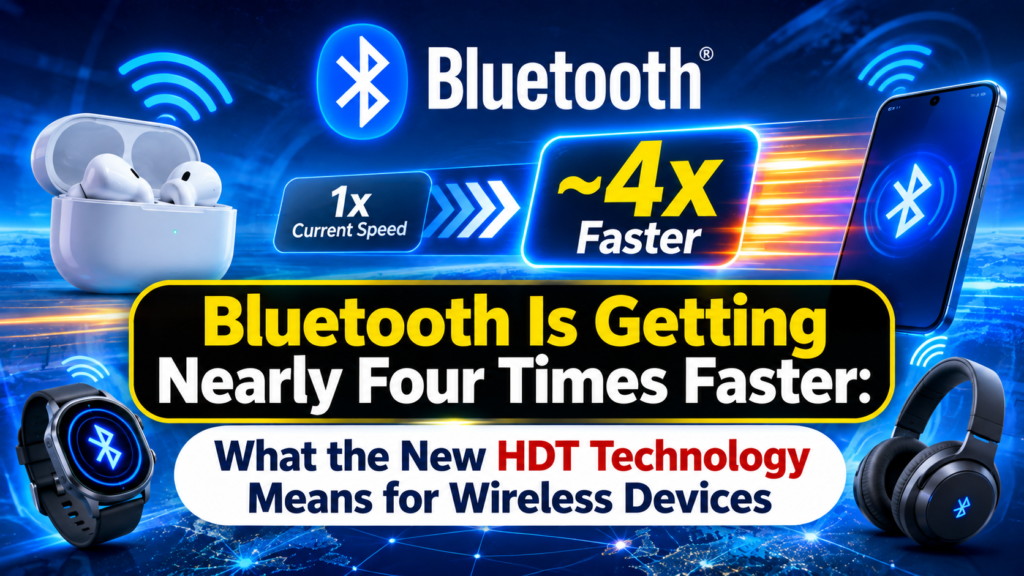
The new technology raises the maximum supported Bluetooth Low Energy (LE) bit rate to 7.5 Mbps, nearly four times the previous 2 Mbps maximum of the LE 2M physical layer. It could support faster wireless data transfers, more advanced audio experiences and improved connectivity across a wide range of devices.
What Is Bluetooth HDT?
Bluetooth High Data Throughput is a new capability designed to make Bluetooth Low Energy transfer information more quickly and efficiently.
Bluetooth LE is widely used in devices that need wireless communication while maintaining low power consumption. It is particularly important for products such as fitness trackers, smartwatches, sensors and connected home devices.
Until now, the maximum supported bit rate of Bluetooth LE’s 2M physical layer has been 2 Mbps. Bluetooth HDT introduces a new physical layer that supports rates of up to 7.5 Mbps.
A physical layer, often called PHY, defines how information is transmitted and received through a wireless signal. By improving this part of the communication process, Bluetooth HDT allows compatible devices to exchange more information over the same wireless connection.
Importantly, HDT is an extension of Bluetooth LE rather than a completely separate wireless technology.
How Much Faster Is the New Bluetooth Technology?
The main improvement is the increase in the maximum supported bit rate.
| Bluetooth LE mode | Maximum supported bit rate |
| Previous LE 2M PHY | 2 Mbps |
| New Bluetooth HDT | 7.5 Mbps |
The new maximum is 3.75 times the previous figure, which is why Bluetooth SIG describes the improvement as nearly four times faster.
However, this is a maximum supported bit rate at the physical layer, not a guarantee that every file will transfer at 7.5 Mbps. Actual transfer speeds depend on device support, connection quality, interference, protocol overhead and the amount of data being sent.
Even with those limitations, the higher rate gives manufacturers more room to develop wireless products that need to exchange larger amounts of information.
Four Major Improvements in Bluetooth HDT
Bluetooth HDT is designed to improve more than just speed. The standard focuses on four areas that affect wireless performance.
1. Faster Data Transfers
Compatible devices will be able to transfer more information in less time.
This could make activities such as synchronising smartwatch data, transferring files and updating connected devices quicker. For example, a fitness tracker collecting detailed activity information could send its recorded data to a smartphone more quickly.
The improvement may also help smart devices receive software updates without keeping their wireless connections active for as long.
2. Greater Wireless Capacity
Wireless devices share limited radio resources. As more products connect and exchange information, managing those resources becomes increasingly important.
Bluetooth HDT improves spectral efficiency, allowing devices to carry more information within the available wireless spectrum.
In practical terms, this creates more capacity for applications that require larger data transfers. It could help support more sophisticated connected products without relying entirely on different wireless technologies.
3. Better Energy Efficiency
Higher transfer speeds do not automatically mean higher battery consumption.
Bluetooth HDT is designed to move more information in less time. This can allow a device’s radio to spend less time actively transmitting data and more time in lower-power states.
For battery-powered products, including smartwatches, hearing aids and wireless sensors, this could be particularly useful.
Actual battery-life improvements will depend on how manufacturers implement the technology and how frequently their devices transmit information.
4. More Reliable Connections
Wireless connections can be affected by distance, walls, electronic equipment and interference from other devices.
Bluetooth HDT introduces communication improvements intended to make data transmission more robust. These include forward error correction, which adds information that helps a receiver recover certain errors during transmission.
The technology also supports different data rates, allowing compatible devices to adjust their transmission approach according to connection conditions.
This is important because a faster connection is only useful when it can also deliver information reliably.
How Could Bluetooth HDT Change Wireless Audio?
One of the most important planned applications is premium wireless audio.
Bluetooth headphones and earbuds have become popular because they remove the need for physical cables. However, wireless audio has limitations when manufacturers want to deliver higher-resolution and lossless sound.
Bluetooth HDT provides additional data capacity that could help support standardised lossless and high-resolution audio, along with more advanced multi-channel surround sound and spatial audio experiences.
Bluetooth SIG identifies standardised premium wireless audio as the first flagship application expected to use HDT in 2027.
This does not mean existing Bluetooth headphones will automatically receive better sound quality. Audio improvements will require compatible hardware, software and supported audio formats. Users will need devices designed to support the new capability.
Other Devices That Could Benefit
The potential applications extend beyond headphones and speakers.
Smartwatches and fitness trackers: Wearables could synchronise larger amounts of health and activity data more quickly.
Smart glasses: Connected glasses could exchange more information with smartphones or other devices, supporting richer features and applications that use remote processing.
Smart home products: Connected devices could receive firmware updates faster and communicate more efficiently with other products.
Hearing aids: Higher data capacity could provide manufacturers with additional options for developing advanced wireless audio and connectivity features.
Industrial equipment: Sensors and connected machines could transfer larger amounts of operational information more efficiently.
These are potential applications rather than a guarantee that every product category will adopt HDT immediately.
Will Existing Bluetooth Devices Support HDT?
No, not automatically.
Bluetooth HDT requires compatible hardware and software. A smartphone, headphone or smartwatch that only supports older Bluetooth capabilities will not gain the new maximum transfer rate through a normal software update unless its hardware already supports the necessary features.
The technology is an optional feature within the recently adopted Bluetooth Core 7.0 specification. Manufacturers will decide whether to include HDT support in their future products.
The new capability is designed to work within the existing Bluetooth LE architecture. Compatible devices can establish connections using the established Bluetooth LE physical layer before switching to HDT when supported.
This approach allows the technology to develop alongside the existing Bluetooth ecosystem rather than requiring every Bluetooth product to be replaced.
When Will Bluetooth HDT Reach Consumers?
Bluetooth SIG announced the adoption of HDT on November 4, 2026, as part of Bluetooth Core 7.0.
However, adoption of a technical standard does not mean compatible consumer products are immediately available. Hardware manufacturers need to develop and test their implementations before products can reach the market.
Bluetooth SIG expects standardised premium wireless audio to be the first major application in 2027. Other manufacturers may explore the technology for wearables, smart home products and industrial devices.
The speed of adoption will depend on product development, hardware support and demand from consumers.
A Faster Future for Everyday Wireless Technology
Bluetooth has evolved far beyond its early role of connecting mobile phones to simple wireless accessories. It now supports a huge range of devices used at home, at work and across industries.
The introduction of Bluetooth HDT is another important step in that evolution. With a maximum supported bit rate of 7.5 Mbps, improved data capacity and features designed to support efficiency and reliability, it gives manufacturers more flexibility to develop advanced wireless products.
The biggest changes may become visible through future headphones, smartwatches, connected devices and other products that need to exchange more information.
For consumers, the important point is that Bluetooth is not being replaced. It is evolving to support the growing demands of modern wireless technology.