


Space travel has always been expensive because rockets traditionally lose most of their hardware after launch. Recovering and reusing rocket components could change that by reducing manufacturing costs, shortening preparation time and allowing more frequent missions.
SpaceX has achieved an important milestone in that direction. On November 14, 2026, the company successfully caught the upper stage of its Starship rocket as it returned from space. The vehicle, known as Ship 42, descended towards its launch site in Texas and was caught by the mechanical arms of the launch tower.
The achievement took place during Starship’s 15th test flight. It was the first successful catch of a Starship upper stage returning from orbit. However, the mission was not a complete recovery of the entire rocket because its Super Heavy booster failed to return to the launch tower.
The result is still a significant development for commercial spaceflight and the future of reusable launch vehicles.
What Happened During Starship Flight 15?
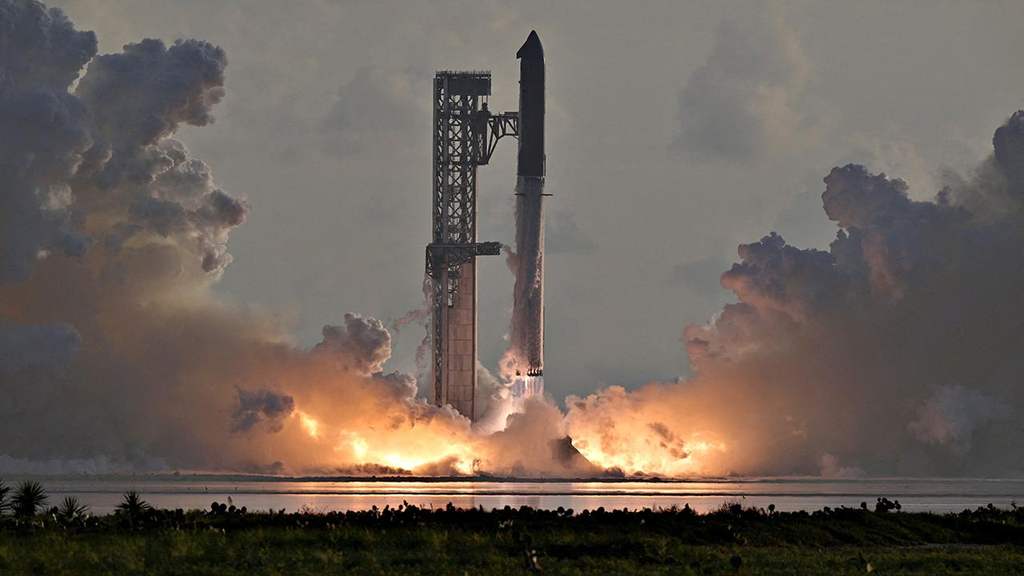
Starship Flight 15 launched from SpaceX’s Starbase facility in South Texas on November 13, 2026.
The mission involved two major components:
- Super Heavy booster: The large first stage responsible for lifting Starship away from Earth.
- Starship upper stage: The spacecraft that continues towards orbit and is designed to carry satellites, cargo and eventually people.
SpaceX planned to recover both components using the mechanical arms of its launch tower, a system commonly known as the chopsticks.
The launch and upper-stage mission achieved several important objectives. Starship reached orbit, deployed 26 Starlink V3 satellites and completed approximately 14 orbits of Earth.
After around 22.5 hours, Ship 42 returned towards its launch site. At approximately 4:20 p.m. Eastern Time on November 14, the vehicle successfully settled into the launch tower’s mechanical arms.
It was the first time SpaceX had caught a Starship upper stage after an orbital flight.
How Did SpaceX Catch a Rocket With Mechanical Arms?
One of the most unusual parts of the Starship programme is its recovery system.
Instead of relying entirely on landing legs, SpaceX has developed a large launch tower equipped with two mechanical arms. The company calls this structure Mechazilla.
The arms are designed to catch returning rocket stages as they descend towards the launch site.
The process requires extremely accurate guidance and timing. A returning vehicle must control its speed, position and orientation before reaching the tower.
During the final stage of its descent, Starship uses its engines to perform a landing manoeuvre. It changes from a horizontal flight position to a vertical position before approaching the launch structure.
The mechanical arms then capture the vehicle and hold it above the ground.
This approach is different from conventional rocket landings, where a vehicle touches down on a landing platform or designated recovery area.
Why Is Catching the Upper Stage So Important?
SpaceX had already demonstrated that it could catch the Super Heavy booster using its launch tower. However, recovering the Starship upper stage is considerably more challenging.
The upper stage travels much farther and returns from orbital flight at extremely high speeds. It must also survive the heat generated when it passes through Earth’s atmosphere.
During reentry, the spacecraft experiences intense heating and aerodynamic forces. Its heat shield must protect the vehicle while it slows down and prepares for landing.
Successfully catching the upper stage demonstrates progress in several areas:
Atmospheric reentry: The vehicle must survive its journey through the atmosphere without suffering damage that prevents recovery.
Guidance and control: Its navigation systems must direct it towards a specific landing location with high precision.
Engine performance: The spacecraft must restart its engines at the correct moment to control its final descent.
Recovery infrastructure: The launch tower must position its mechanical arms accurately enough to capture the returning vehicle.
These capabilities are essential if SpaceX wants to reuse Starship regularly rather than treat each flight as a one-time mission.
Why Did the Super Heavy Booster Fail to Return?
Although the upper-stage catch was successful, the first stage did not complete its planned recovery.
During the November 13 launch, the Super Heavy booster experienced a problem during its return towards the launch site. SpaceX later reported that an early end to its boostback burn was associated with a low-fuel-mass alarm.
The booster was no longer in the correct position to continue towards a tower catch. Its automated guidance system therefore aborted the recovery attempt and directed it towards an offshore landing in the Gulf of Mexico.
The booster subsequently exploded before reaching the water.
This meant that SpaceX recovered the Starship upper stage but did not recover both components of the launch vehicle during the same mission.
The distinction is important. The flight demonstrated the first successful upper-stage catch, not the complete recovery of an entire Starship rocket.
How Could Fully Reusable Rockets Change Space Travel?
Traditional rockets are expensive partly because many components are discarded after launch. Building replacement hardware for every mission limits how frequently launch vehicles can fly.
A fully reusable rocket could change this model.
If both the booster and spacecraft can be recovered, inspected, refurbished and launched again, companies may eventually reduce the cost of sending payloads into orbit.
The potential benefits include:
- More frequent launches: Reusable vehicles could support a higher launch schedule.
- Lower hardware costs: Reusing expensive rocket components could reduce the need to manufacture replacements for every flight.
- Satellite deployment: More affordable launches could help expand communications, navigation and Earth-observation satellite networks.
- Space exploration: Reusable spacecraft could support missions involving cargo, equipment and eventually astronauts.
- Future space infrastructure: Frequent launches could make it easier to transport supplies and materials for larger projects in orbit.
However, successful recovery alone does not prove that a rocket is ready for rapid commercial reuse. Engineers must still inspect the vehicle, assess damage, replace components where necessary and demonstrate that it can fly again safely.
What Does Starship Have to Do With NASA’s Moon Missions?
Starship is not being developed only for satellite launches.
NASA has selected a version of Starship as part of its Artemis programme to transport astronauts from lunar orbit to the Moon’s surface.
The spacecraft is intended to support future crewed lunar missions by carrying astronauts, equipment and supplies.
However, several major technical challenges remain before it can perform that role.
One important requirement is in-orbit propellant transfer. Starship is expected to receive additional fuel from other spacecraft in orbit before travelling to the Moon. Demonstrating that process reliably is essential for the planned lunar architecture.
SpaceX must also continue developing its life-support systems, heat shield, landing capabilities and operational safety procedures for human missions.
The successful upper-stage catch is a recovery milestone. It does not mean Starship is already ready to transport astronauts to the Moon.
What Challenges Must SpaceX Solve Next?
The November flight demonstrated a major capability, but the programme still has important work ahead.
Recovering both rocket stages: SpaceX needs to demonstrate successful recovery of the Super Heavy booster and Starship upper stage during the same mission.
Heat shield improvements: The spacecraft must survive repeated atmospheric reentries without requiring extensive replacement work after every flight.
Rapid refurbishment: A reusable rocket becomes more economically useful when it can be inspected, prepared and launched again without lengthy maintenance periods.
In-orbit refuelling: Future lunar missions require the ability to transfer propellant between spacecraft in orbit.
Reliable operations: Repeated successful flights will be necessary to establish confidence in the rocket’s performance and recovery systems.
Each challenge requires testing, engineering improvements and additional flight experience.
The Future of Reusable Spacecraft
SpaceX’s successful catch of Ship 42 marks an important moment in the development of reusable rockets. For the first time, the company recovered a Starship upper stage directly at its launch tower after an orbital flight.
The Super Heavy booster did not complete its planned recovery, so the goal of recovering the entire launch vehicle in one mission remains unfinished.
Nevertheless, the achievement demonstrates that a spacecraft designed for orbital flight can return to its launch site and be captured by a mechanical tower system.
If SpaceX can make this process reliable and repeatable, it could change how satellites are launched, how space infrastructure is built and how future missions travel beyond Earth.
The next major milestone will not simply be catching Starship once. It will be proving that the vehicle can return, undergo inspection and fly again safely and efficiently.