
A routine technology upgrade has caused one of the most significant disruptions to US air travel in recent years. On November 13, 2026, the Federal Aviation Administration (FAA) issued a nationwide ground stop after a telecommunications problem affected its air traffic control network.
Thousands of flights were cancelled or delayed, leaving passengers stranded at airports across the country. The disruption continued over the weekend, even after the FAA lifted the ground stop.
Investigators traced the incident to problems involving network equipment installed during a communications upgrade. The work was intended to replace ageing copper telephone lines with faster fibre-optic connections. Instead, a router problem overloaded parts of the FAA’s network and disrupted communications between air traffic control facilities.
The incident highlights how a failure in a relatively small part of a technology network can affect an entire transportation system.
What Happened to the US Air Traffic Control System?
The disruption began on Friday afternoon, November 13, when the FAA detected instability in its communications network.
The problem affected the systems used by air traffic control centres to exchange information. Because the agency could not confidently rely on the affected network, it ordered a nationwide ground stop for departing flights.
A ground stop is an aviation safety measure that temporarily prevents aircraft from departing for affected destinations or across a specified area. In this case, the order affected departures across the United States.
The FAA later lifted the restriction after engineers stabilised the network. However, airlines were left with aircraft and crew in the wrong locations, creating delays and cancellations that continued after normal departures resumed.
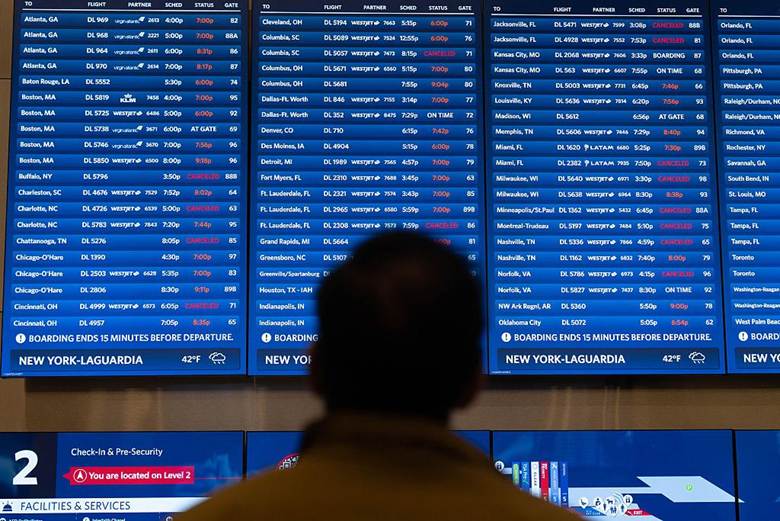
According to Reuters, nearly 10,000 flights had been cancelled by late Friday. The disruption affected more than 20,000 flights over the following period, including cancellations and delays.
The incident became the third nationwide ground stop of the 21st century, following the September 11, 2001 attacks and a major FAA system outage in 2023.
What Caused the Nationwide Flight Disruption?
US Transportation Secretary Sean Duffy said the problem was connected to routine maintenance performed by L3Harris, a contractor working on FAA communications infrastructure.
The upgrade involved replacing old copper communication lines with modern fibre-optic connections at remote facilities.
However, after the equipment was installed, a router began generating an unusually high volume of network connections. Officials said two locations were sending approximately 1,000 connection attempts every four to five seconds.
This abnormal traffic overloaded parts of the communications network and caused instability across multiple air traffic control centres.
The FAA identified the problem and disabled the affected equipment to stabilise the network. Officials said they were investigating whether the failure resulted from installation errors, user error or faulty equipment.
The exact technical root cause had not yet been conclusively established in the latest reports.
How Can One Router Disrupt an Entire Flight Network?
To understand the incident, it helps to know how air traffic control systems communicate.
Air traffic controllers need reliable information from different facilities to manage aircraft movements. These systems exchange operational data, including information used to coordinate aircraft routes and maintain safe separation.
Routers help move information between networks and connected devices. They examine where data needs to go and direct it through the appropriate network paths.
When a router behaves incorrectly, it can send excessive traffic, interrupt connections or prevent other equipment from communicating properly.
In the FAA incident, officials described an unusually high number of connection attempts that overloaded parts of the network.
This is important because air traffic control does not depend on one computer or one airport. It relies on connected facilities that exchange information continuously.
When communications become unstable, controllers may not be able to rely on the information needed for normal operations. Restricting departures can therefore become the safest option until the problem is understood and controlled.
The incident did not mean that every radar system or communication channel completely stopped working. Officials said the network instability affected the ability of routers to exchange reliable data.
Why Was the FAA Replacing Copper Wires With Fibre Optics?
Copper cables have been used for decades to carry voice and data communications. However, modern networks increasingly use fibre-optic technology because it can carry much larger amounts of information over long distances.
Fibre-optic cables transmit information using light rather than electrical signals.
Some important advantages include:
- Higher capacity: Fibre can carry much more data than traditional copper connections.
- Long-distance communication: It can transmit information over long distances with relatively low signal loss.
- Resistance to electrical interference: Fibre is less affected by electromagnetic interference than copper.
- Modern network support: It provides a stronger foundation for newer digital communication systems.
The FAA has been working to replace older telecommunications infrastructure as part of a wider modernisation programme.
According to Reuters, the agency spends approximately $1 billion annually maintaining its older copper-wire system. L3Harris said it had completed more than 70% of the planned conversion from copper to fibre.
However, the incident shows that upgrading old infrastructure introduces its own technical challenges. New equipment must work correctly with existing routers, communication systems and operational software.
How Many Flights Were Affected?
The disruption extended far beyond the initial five-hour ground stop.
According to Reuters reporting, nearly 10,000 flights had been cancelled by late Friday. The impact continued on Saturday and Sunday as airlines struggled to reposition aircraft and crews.
More than 11,500 US flights were reported cancelled or delayed on Sunday, November 15, according to flight-tracking data cited by Reuters.
The disruption affected major airlines and airports, creating delays for passengers travelling for business, holidays and other commitments.
Even after the FAA reopened the airspace, airlines could not immediately return to their original schedules. Aircraft were stranded at different airports, crew members were out of position and passengers needed to be rebooked.
Transportation officials expected flight operations to return to normal by Monday, although the full recovery depended on airlines clearing the remaining backlog.
Was the FAA Network Hit by a Cyberattack?
The incident initially raised questions about whether a cyberattack had affected the aviation network.
However, officials said there was no evidence of a foreign cyberattack or another deliberate act.
The FAA and Transportation Department linked the disruption to equipment problems following routine network maintenance.
This distinction matters because a network outage does not automatically mean that hackers were involved. Hardware failures, configuration mistakes, software problems and excessive network traffic can also interrupt critical services.
The investigation focused on the routers involved in the maintenance work and the unusual traffic they generated.
What Does This Reveal About Modern Technology Infrastructure?
The FAA incident demonstrates how dependent essential services have become on connected digital systems.
Airports, airlines, hospitals, banks and government departments rely on networks that must operate continuously. A failure in one important part of that infrastructure can affect many organisations at the same time.
It also highlights the difficulty of replacing ageing technology without interrupting existing services.
Organisations often need to maintain older equipment while installing new systems. This creates a complex environment in which different generations of hardware and software must work together.
Several lessons emerge from the incident:
Test upgrades before deployment: New network equipment should be tested under realistic conditions before being connected to critical operational systems.
Use controlled rollouts: Large infrastructure upgrades should be introduced gradually, with clear procedures for reversing changes if something goes wrong.
Monitor unusual network traffic: Automated monitoring can help engineers identify abnormal connection patterns before they spread across a wider network.
Maintain backup communication systems: Critical services need alternative ways to communicate when primary network equipment fails.
Plan for recovery: Organisations must prepare procedures for restoring services and managing the consequences of a disruption.
These measures cannot prevent every technical failure, but they can reduce the likelihood that a local problem becomes a nationwide incident.
The Future of Air Traffic Control Depends on Reliable Networks
The November 13 incident was not caused by an advanced cyberattack or a sophisticated new technology. It followed a routine infrastructure upgrade that exposed weaknesses in a network supporting one of the world’s busiest aviation systems.
The FAA has stabilised the affected network, while investigations into the equipment failure continue. The incident has also renewed attention on the need to modernise ageing air traffic control infrastructure.
Replacing copper lines with fibre is an important step towards a more capable communications network. However, modernisation must include proper testing, equipment compatibility and reliable backup systems.
As transportation systems become increasingly connected, network reliability is becoming just as important as the physical infrastructure itself.
The lesson from this incident is clear: even a small technology failure can have consequences far beyond the equipment involved.